Lemberk Granary in cooperation with Kuzebauch Gallery
The concept of a “boundary” essentially means a dividing line, or terminator, between two different environments. A subtle semantic difference exists between this and the word “border”, for the latter tends to represent a dividing line between two comparable areas, for example fields. It is a man-made concept, where in reality a true natural border may not necessarily exist. Conversely, a boundary can be characterised as a dividing line between areas of differing qualities, whereby the separate entities tend to be markedly different in nature, with the very question of applying boundaries typically being far more complex. One such example is that of a cellular membrane, which ensures the proper interaction by the cell with its surroundings. Such a membrane, by definition, must have the ability to allow certain substances in, while blocking others. Which means that even a boundary incorporates a border, with the latter thus taking a subordinate position to the former. Or stated more precisely, a boundary inherently contains two, diametrically opposed – and yet mutually complementary principles: static separation and active motion. On the one hand, a border represents a passive and static line of division; conversely, motion is an active and dynamic phenomenon. A border primarily divides; whereas motion unites – and the goal of boundaries is precisely to enable and regulate such motion. From the above, therefore, it is possible to surmise that while borders can limit contact, boundaries, conversely, exist to facilitate some form of exchange and communication.
From the point of view of humankind and its existence, one notable example of a boundary is found in our concept of the home, namely the demarcation of interior and exterior spaces. A home is a human manifestation, an artificial construction, permeable for corporeal beings, for air, for light, and for its very aesthetic appearance. Accordingly, it takes the infinity and intrigue of the surrounding world and creates a closed, clearly defined space in which people can find privacy, safety and intimacy. Homes also to some degree reflect the personalities of those who built and who ultimately inhabit them – and vice-versa, with homes shaping the personalities of their inhabitants. This duality is a key quality of all types of boundaries and is found in many places designed to separate us from the outside world. Another example is found in invisible barriers, namely the protective zones which living organisms mutually maintain; in humans, this manifests itself nonverbally in the concept of personal space. Additional readily apparent dividers can be found in our clothing, or in the very physical boundaries of our own bodies. All of these ultimately represent boundaries that define us as individual human beings interacting with our natural surroundings.
Boundaries are also critical subject matters for artists, albeit not necessarily explored in such semantic detail. Rather, boundaries often serve as artistic springboards, for example inspiring architects designing spaces in which people are to live; or for sculptors and painters, depicting people and having to enter the intimate spaces of their subjects and thus to express their internal worlds. Understandably, therefore, boundaries are also natural subject matters for the figurative and abstract creative realms.
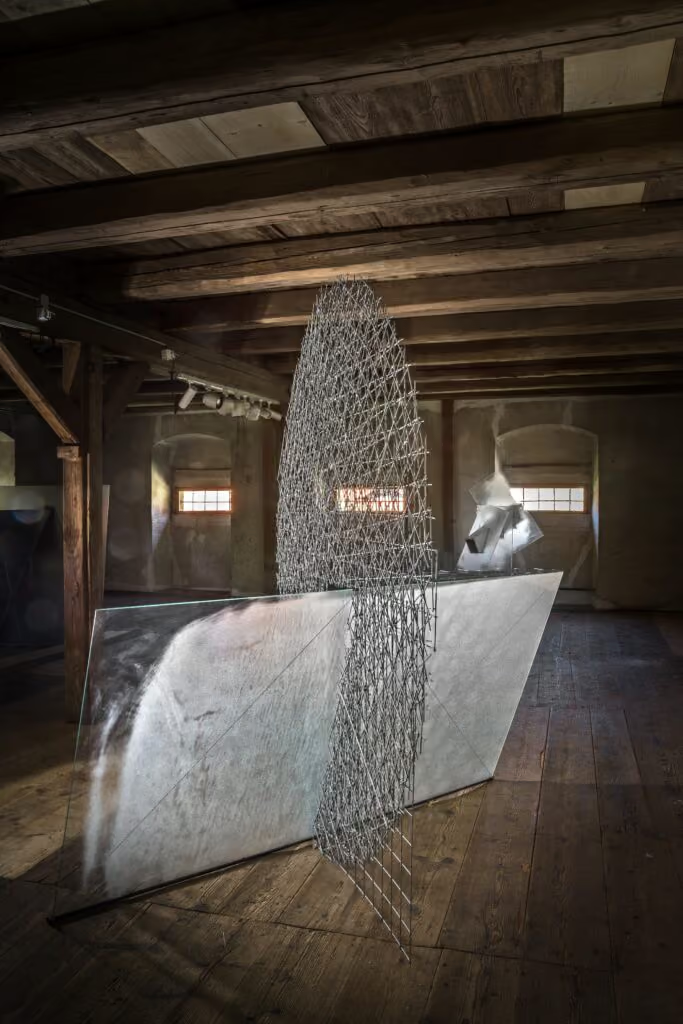
For glass artist Petr Stanický, the above-described explorations take on an even deeper meaning. Indeed, at this most recent exhibition of his works, we find this interpretative duality very much at play. Such artistic directions were essentially preordained from the time of Stanický’s studies during the 1990s at the Academy of Arts, Architecture and Design in Prague (UMPRUM). Stanický first studied under the renowned sculptor Kurt Gebauer, for whom the human form was a key artistic springboard, and who also advocated for figurative sculpting to play an active role for art within public spaces. Conversely, Stanický’s second professor, Marian Karel, advocated for art as emerging from the concept of space, building art objects from glass panels – but also always relating such works to human dimensions and perceptions. Both of these approaches were then incorporated in to the approach of Jiří Beránek, the third and most influential of Stanický’s artistic mentors (and whose assistant at UMPRUM he later became). Beránek’s approach stemmed from a classical tradition of figurative sculpting, albeit slowly moving towards a sculpting-in-spaces concept, and even devising an original artistic notion of “inhabited sculptures”. It thus is no coincidence that Petr Stanický, on the occasion of the Boundaries exhibition, installed one of Beránek’s sculptures that he had previously rescued in a special spot at Granary Lemberk (Sýpka Lemberk).
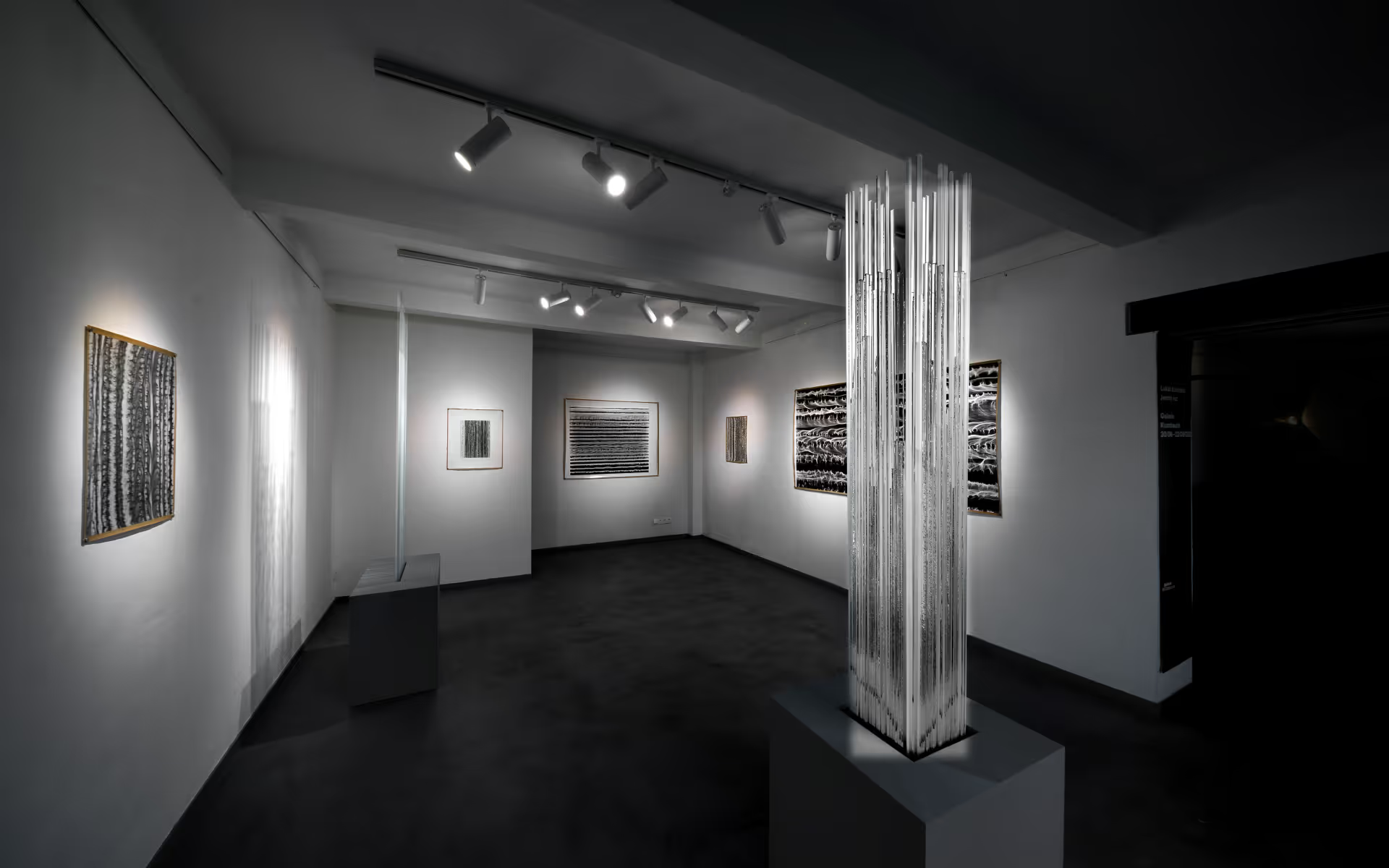
As the exhibition’s title suggests, boundaries, or borders associated with the movement of humans, is a strong theme of Petr Stanický’s works at Lemberk. In a very formal sense, the displayed art objects exist at a boundary between architecture and sculpting, or between architecture and imagery. Moreover, Stanický’s main stated aim in choosing such a title is an exploration of the idea that man’s relationship to spaces – one that otherwise we often take entirely for granted and neglect to consider – can even take on metaphysical dimensions. Or simply put, it is yet another boundary, this time between our everyday experiences and that which transcends it via a realisation of one’s own physical existence in the world.
Z výše řečeného plyne, že rozhraní je důležitým tématem i pro umělce, byť to takto explicitně většinou neformulují. A to tématem univerzálním, které řeší jak architekt, budující prostor, v němž člověk žije, tak třeba sochař nebo malíř, portrétující člověka a snažící se vstoupit do jeho intimního prostoru a vyjádřit jeho vnitřní svět. I proto jde o téma, které zcela přirozeně spojuje figurativní a konstruktivně-abstraktní dimenzi. Pro Petra Stanického má výše napsané ještě hlubší platnost a na současné výstavě dokonce najdeme oba typy prací. Směřování jeho tvorby určila už na počátku jeho studia na Vysoké škole uměleckoprůmyslové v devadesátých letech. Zde byl nejdříve žákem Kurta Gebauera, sochaře, který od lidské postavy vyšel, figurální sochařství však překračoval směrem k aktivní roli umění ve veřejném prostoru. Naproti tomu druhý jeho profesor, Marian Karel, z prostoru vycházel a budoval ho svými objekty ze skleněných desek, vždy ho ale vztahoval k lidské proporci a percepci. Oba přístupy pak v sobě ztělesňuje Jiří Beránek, ten nejdůležitější Stanického učitel, jehož asistentem na stejné škole se pak stal: Beránek vyšel z klasické tradice figurativního sochařství, ovšem postupně se od ní odpoutal a směřoval k sochám-prostorům, nebo dokonce k originální myšlence „obydlené sochy“. Není náhodou, že Petr Stanický u příležitosti současné výstavy jednu Beránkovu sochu, kterou už dříve zachránil, nainstaloval v dalším prostoru lemberské sýpky.
Jak název napovídá, rozhraní, tedy hranice vztažená k pohybu člověka, je tématem i těch prací, které Petr Stanický nyní vystavuje v Lemberku. A to dokonce ve zcela konkrétním smyslu, kdy se po formální stránce pohybují na pomezí architektury a sochy, respektive architektury a obrazu. Ovšem tím, co chtěl volbou názvu vyjádřit především, je fakt, že vztah člověka a prostoru, nad kterým nijak nepřemýšlíme a považujeme ho za něco zcela přirozeného, může z jistého pohledu nabývat až metafyzický rozměr. Tedy další rozhraní, tentokrát mezi naší každodenní zkušeností a něčím, co ji překračuje ve smyslu uvědomění si vlastní fyzické existence ve světě.
Kurátor výstavy: Marcel Fišer