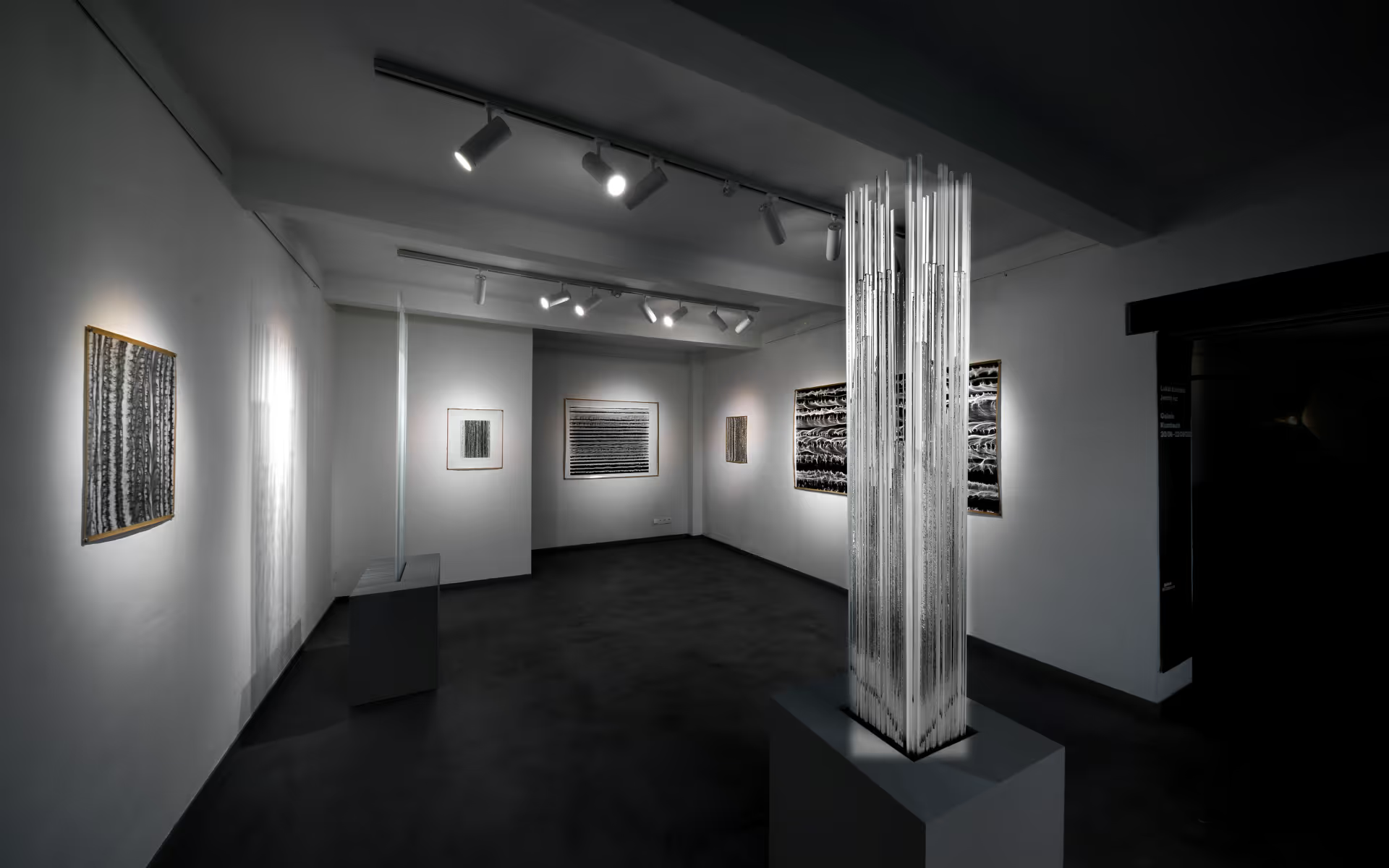
Harmony, as well as a concurrent sense of tension generated by a combination with forms that by definition reject the very notion of coexistence (thus inversion). Such is the overall “gestaltism” of the glass art sculptures of Ilja Bílek. His interpretation of the harmonic form engenders pleasant sensations in observers – albeit not ones related to shallow likability. The combination of such a seemingly banal and common feature of glass art (its attractiveness), including in its subsequently cut-glass manifestations, can not be said to belong to Bílek’s style. For that, he is far too noble an artist. The artist avoids trite glass effects, instead always giving priority to the unusual and unexpected. As a kind of glass artist aristocrat of his age, Bílek is almost contemptuously indifferent to current trends, even ones that could be described as seductively authoritative, such as those pioneered by his former teacher Professor Stanislav Libenský. Bílek has adopted only a few principles from his former mentor: a responsibility towards passing on traditions to a younger generation, professional discipline, and perhaps also a positive attitude towards drawing and painting. As an artist (and perhaps also as a person) Bílek gives the impression of a rational ascetic, who, despite his passions, manages to maintain a sense of calm detachment. And yet Bílek reveals his sense for inversion – that his inherent English reserve, or “poker face” only masks his own emotions – ones that nonetheless fester beneath the surface and provide endless artistic inspiration.
As someone who rejects obviously alluring forms, Bílek resisted, for example, a 1970-80s glass art trend towards prisms and cubes – one which even gained international attention. Rejecting the styles laid out by older contemporaries such as Yan Zoritchak, Marian Karel, Aleš Vašíček, and Oldřich Plíva, Bílek opted to not go down the path of so-called “prismic sculptures”. He also turned his nose up at other successful, albeit short-lived fads. After graduating in the 1970s, Bílek decided to chart his own path: rather than contrasting his subject matters with geometric components, Bílek’s works integrate ingenious compositional solutions in association with curving lines. In so doing, the artist discovered a longstanding affiliation for examining contrasts, as evidenced in much of Bílek’s works thereafter.
To this day Bílek’s works profess a particular kind of inversion that rests somewhere between the rigidly geometric and organic, for example the creation of cast opaque glass platters. Nor does Bílek waver in combining glass with other “lowly” materials such as plastics. Nonetheless, the artist remains primarily a modernist – one who feels no need to relate either internal emotions or day-to-day events, or to create “glass Facebook entries” or to illustrate his thoughts on the issues of the day, as is often the case with postmodernists. Rather, the stories evident in Bílek’s works choose to tell a different kind of story – one focused on universal phenomena, symbols of human relationships, and the principles of existence….
Ilja Bílek is among the most significant contemporary Czech glass artists working today. He is also a celebrated art teacher in his own right, having taught several generations of up-and-coming glass artists at Jan Evangelista Purkyně University in Ústí nad Labem (UJEP) from the mid-1990s. Ilja Bílek’s works are a regular feature of numerous collections of displayed glass art, both at home and abroad.


Jako odpírač svůdných vzorů odolal následování tzv. kostičkářů, kteří se objevili v 70. až 80. letech a rychle získali nadnárodní věhlas. Mladší spolužák těchto protagonistů, tj. Jána Zoričáka, Mariana Karla, Aleše Vašíčka, a Oldřicha Plívy se zřekl jít cestou programu tzv. prismatické plastiky. Vzepřel se programu veleúspěšnému, avšak snadno vyčerpatelnému, jak se po určité době ukázalo. Po absolutoriu v 70. letech začal po svém: v kontrastu s geometrickými částmi zpracovávaných témat zapojoval vynalézavá kompoziční řešení ve spojení s křivkami. Tak našel nejen svou vlastní, ale hlavně dlouhodobou cestu kontrastu, která měla v průběhu času řadu vývojových etap a cyklů.
Bílek dodnes vyznává jistý druh inverze stojící mezi rigidně geometrickým a organickým, jako jsou třeba rozteklé placky z opakního skla. Neváhá ani před spojením skla s dalšími „zatracovanými“ materiály, jako jsou třeba umělé hmoty. Zůstává však stále hlavně modernistou, který nepotřebuje sdělovat osobní a denní věci, budovat „sklářské facebooky“ a ilustrovat svůj postoj k tomu, co momentálně žije tiskem, jak to mají postmodernisté… Děje Bílkových prací také vyprávějí a sdělují, ale o obecných jevech, symbolech vztahů, o principech existence… existence… Bílek patří mezi významné představitele českého skla, mezi oceňované pedagogy, protože v Ústí nad Labem na UJEP po polovině devadesátých let vychoval několik generací vynikajících umělců – sklářů, kteří se k němu hlásí jako k celoživotní autoritě. Patří i mezi ty, jejichž práce jsou v nejvyšší míře právem zastoupeny v řadě sbírek soudobého umění a skla doma i v zahraničí. Sylva Petrová, kurátorka výstavy